


“We and Us, Not I": Bob McGavin on the 1960s Roots of Husky Rugby
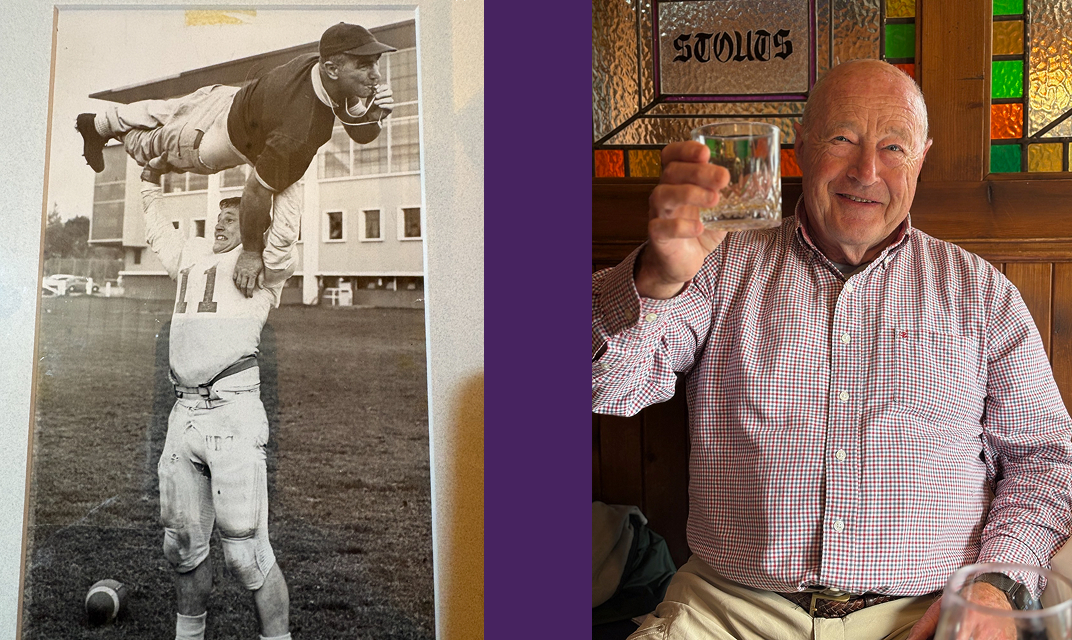
Before Bob McGavin was a Canadian diplomat, a bank executive, or an 84-year-old birdwatcher, he was a 20-something Canadian sprinter with a bad neck injury and a lot of unused competitive energy.

Husky Rugby Community—
One of the things that holds any great club or team together is a strong sense of its history, and Husky Rugby is no exception.
Over the years, the club has experienced glorious victories, heartbreaking defeats, epic adventures, legendary players, myths, rumors, and—by now—decades and decades of ruggers coming through the program. Unfortunately, the truth is that we haven’t always done a very good job of capturing and preserving that history.
The Board has decided that it’s time to change that while we still can.
Today, we are unveiling the first in a series of interviews with players from the past. Our goal is to build a video library of interviews, stories, and other documentation that captures the rich and often colorful history of Husky Rugby.
We’ve engaged a journalist who knows how to ask great questions and, just as importantly, how to turn those conversations into compelling stories. We’re turning her loose on the project.
We’ll start with the 1960s and work our way through the decades, capturing the people, stories, characters, traditions, triumphs, and adventures that have shaped the club. Hopefully, over time, we’ll create a living record of Husky Rugby’s history that future generations of Dawgs can learn from and enjoy.
If you have suggestions for people we should interview, or know how to track down some of the legends of the past, please let us know. Likewise, if you have a story, legend, or long-standing Husky Rugby myth that you think should be told, preserved, or investigated, send it our way. We’ll find a way to dig into it.
This promises to be a fun project, and we hope you’ll enjoy the opportunity to learn more about the people and stories that came before you, and the heritage that makes Husky Rugby what it is today.
Interview with Bob McGavin
Before Bob McGavin was a Canadian diplomat, a bank executive, or an 84-year-old birdwatcher, he was a 20-something Canadian sprinter with a bad neck injury and a lot of unused competitive energy.
It was 1965 on the steps of Edmonson Hall when a chance encounter changed his time at the University of Washington completely. A stranger walked up to Bob and asked if he knew anything about rugby. Within days, he was handed a whistle, a bag of white line-marking lime, and a ragtag squad of just 11 students. What started as a favor for a team with no budget, no university backing, and a pitch they had to line by hand laid the groundwork for what Husky Rugby still stands on six decades later.
Preparing for this interview, Bob admitted he didn't keep diaries from those years. Curious if any record remained, he asked ChatGPT if a coach named McGavin existed in 1960s UW history. He laughed, recalling the AI's instant answer: “Absolutely correct, there was.”
At the time, rugby was practically unknown on campus and far removed from traditional, high-pressure college sports. Bob saw it simply as a way to build friendships and let off steam while adjusting to life in Seattle. His ground rules for the team were straightforward: show up to practice twice a week, wash your jersey before match day, and respect the "third half" (the post-game social gathering with the opposing team). He recalls the third half as the best part of the game, joyfully remembering how it stripped away the intensity of competition and highlighted fun as the true purpose of sport.
Coaching between 1965 and 1968 also meant managing a team under the heavy shadow of the Vietnam War. Bob recalls the desperate pleas from students during his teaching assistant days: “You can’t give me a C, or else I’ll go to Vietnam.” For American students facing the constant pressure of military draft deferments, rugby was a rare sanctuary to decompress, escape daily anxieties, and be “just kids.”
It also meant playing as underdogs, operating with zero funding and embracing scrappy adventures, like sleeping on the beach during cross-country tournaments or playing a match in an empty Rose Bowl stadium without a crowd.
The Husky Rugby team still carries the raw, authentic spirit of those early years, a time marked by “horsepower” and liveliness. It preserves that original edge, which set in motion six decades of student-athletes coming together to compete hard and have fun.
In a world filled with cutting-edge technology, high academic pressure, and less time for leisure, supporting rugby at the University of Washington gives new generations the gift of forming unforgettable bonds during their formative college years. It ensures the program can thrive while preserving its natural rawness, allowing students to remain, above all, just students.
More News
.jpg)
Remembering Mark “Tav” Taverniti
The Husky Rugby community is saddened by the passing of Mark “Tav” Taverniti, a great athlete, a good friend, a good rugger, and a good guy.
Remembering Mark “Tav” Taverniti
The Husky Rugby community is saddened by the passing of Mark “Tav” Taverniti, a great athlete, a good friend, a good rugger, and a good guy.

.jpg)
New Board Member Announcement - Scott Ward
Husky Rugby Alumni Association Welcomes Scott Ward to the Board.
New Board Member Announcement - Scott Ward
Husky Rugby Alumni Association Welcomes Scott Ward to the Board.
Announcing New Team Leadership
We're excited to announce the student leadership team that will lead UW Rugby through the 2026–2027 season.
Announcing New Team Leadership
We're excited to announce the student leadership team that will lead UW Rugby through the 2026–2027 season.